

The ZED Stereo Camera is a lightweight depth sensor based on passive stereovision. It outputs a high resolution side-by-side video on USB 3.0 that contains two synchronized left and right video streams. Using the ZED SDK, the graphics processing unit (GPU) from a host machine computes the depth map from the side-by-side video in real-time
https://www.stereolabs.com/zed/specs/


Our method scales to extremely large datasets, such as the 372M triangle St. Matthew statue acquired by the Digital Michelangelo project [Levoy et al. 2000]. The left side shows a visualization of the position field, and the right is the final quadrilateral mesh. The entire process takes 9 minutes and 18 seconds.
http://igl.ethz.ch/projects/instant-meshes/instant-meshes-SA-2015-jakob-et-al.pdf
We present a novel approach to remesh a surface into an isotropic triangular or quad-dominant mesh using a unified local smoothing operator that optimizes both the edge orientations and vertex positions in the output mesh. Our algorithm produces meshes with high isotropy while naturally aligning and snapping edges to sharp features. The method is simple to implement and parallelize, and it can process a variety of input surface representations, such as point clouds, range scans and triangle meshes. Our full pipeline executes instantly (less than a second) on meshes with hundreds of thousands of faces, enabling new types of interactive workflows. Since our algorithm avoids any global optimization, and its key steps scale linearly with input size, we are able to process extremely large meshes and point clouds, with sizes exceeding several hundred million elements. To demonstrate the robustness and effectiveness of our method, we apply it to hundreds of models of varying complexity and provide our cross-platform reference implementation in the supplemental material.

Being able to see through walls is definitely a superpower I would pay to have. And while it’s not entirely possible yet, researchers at MIT’s Computer Science and Artificial Intelligence Lab are pretty close.
They’ve built a device, called RF-Capture, that uses Wi-Fi signals to identify and monitor human silhouettes through walls.
It works by emitting wireless signals through the walls, which then bounce off the human bodies on the other side. As the person moves, the RF-Capture takes snapshots in order to stitch the images together and create a silhouette.
It may seem basic at first to some people, but the researchers have said that it’s sophisticated enough to tell the difference between fifteen different people and even analyze a person’s heart rate and breathing pattern.
I mean the obvious use for this is to spy on the people next door, but MIT has grander plans, saying it could be used in movie-making – actors have to wear markers on their bodies for motion capture at the moment, but there’s no need for them with the RF-Capture.
The team is also working to develop a spin-off device that can be used in the home for eldercare and could be set to call emergency services if someone falls. It could also be programmed to manage things like lighting, heating and the TV as well.


Computational Photography research from JKU demonstrates method to implement depth of field effect using standard smartphone tech:

We present a novel approach for guided light-field photography using off-the-shelf smartphones. In contrast to previous work that requires the user to decide where next to position a mobile camera, we actively compute and visualize during runtime a recommendation for the next sampling position and orientation taking into account the current camera pose and required camera alignments. This supports efficient capture of various types of large-field-of-view light fields in just a matter of minutes and without specialized camera equipment. To further reduce the overall capture time, we describe an extension of our guidance algorithm to collaborative light-field photography by small groups of users.


In the prophetic 1997 film “Face/Off,” John Travolta figures that the only way to avoid going back to prison was to surgically replace his face with that of Nicolas Cage’s. Although medical science has not really gotten to the point where that isn’t still completely laughable, a new technology out of Stanford University is getting us closer.
Researchers have figured out how to make one person’s face mimic the facial expressions of another, in real-time video. The method, announced in a paper (pdf) that will appear in a special edition of the scientific journal ACM Transactions on Graphics later this year, uses a regular computer, special cameras, and some seemingly magical new software.
The research team comprises computer scientists from Stanford, the Max Planck Institute, and University of Erlangen-Nuremberg in Germany.
Their system requires a bit of set-up: A pair of cameras needs to calibrate with each new face, then renders it in digital 3D. Then the program tracks both subjects’ facial expressions using cameras that can sense depth, texture, face shape and location, and maps movements of prominent facial features like nose, mouth, and eyes, from one person’s face onto the avatar of the other. The end result: You can appear to control a friend’s face with your own.
(To make up for the fact that not everyone’s mouths are the same size, the program puts in an eerily fake set of perfect teeth to fill in any gaps.)

Matthias Niessner, one of the researchers on the project, told Quartz that the team’s main motivation was to create something that could aid multi-language videoconferences like Skype.

In the future, interpreters could translate someone speaking in real time, and the end user would just see the person they’re watching speak to them in their own language.
In their research paper, the team said they believe that this technology could pave the way to having photo-realistic avatars in virtual reality settings.
Niessner added that the team was also interested in applying this technology to movies, dubbing them for foreign audiences. “Most important though: It’s a crap ton of fun playing around with the system,” Niessner said.
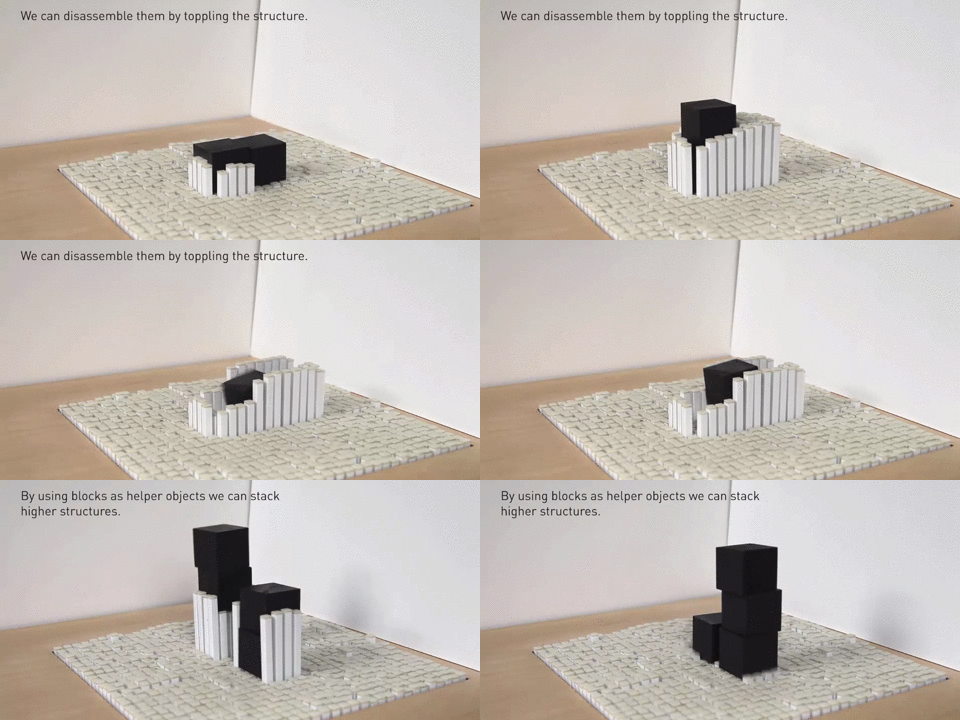
Pin-based shape displays not only give physical form to digital information, they have the inherent ability to accurately move and manipulate objects placed on top of them. In this paper we focus on such object manipulation: we present ideas and techniques that use the underlying shape change to give kinetic ability to otherwise inanimate objects. First, we describe the shape display’s ability to assemble, disassemble, and reassemble structures from simple passive building blocks through stacking, scaffolding, and catapulting. A technical evaluation demonstrates the reliability of the presented techniques. Second, we introduce special kinematic blocks that are actuated and sensed through the underlying pins. These blocks translate vertical pin movements into other degrees of freedom like rotation or horizontal movement. This interplay of the shape display with objects on its surface allows us to render otherwise inaccessible forms, like overhangs, and enables richer input and output.

Go behind the scenes of the facial animation technology that will make Cloud Imperium Games’ Squadron 42 a true interactive movie!
Roberts Space Industries is a spacecraft manufacturer within the persistent-world game «Star Citizen» and its companion single-player spaceflight sim, «Squadron 42.» RSI is also your portal for information, updates, and purchases of your very own spacecraft with which to trade, plunder, and protect the citizens of Star Citizen.


If you’ve got a spare selfie around, you can now 3-D-print a scale model of your head thanks to a new technology by Adobe that converts 2-D photographs into 3-D models.
To be presented tonight at Adobe MAX Sneaks, the Photoshop maker’s annual peek inside their development labs, 3-D Portraits smartly recognizes faces, eyes, mouths, and hair, and then efficiently turns them into a usable 3-D model. This is actually already possible in Photoshop, but it requires a number of tedious manual steps, and the results can range in quality. Thanks to research by Menglei Chai, a PhD student from Zhejiang University, and a team of Adobe Research scientists, though, they’ve now figured out how to largely automate the process.
It might seem like a novelty, but it’s easy to see how this would be useful to the design process. Adobe themselves note that this technology could be used to bootstrap the complicated 3-D modeling process. Game developers or CGI designers, for example, could start their development process by converting still photographs into 3-D models.
There are also applications for standard photo editing. Adobe points out that being able to calculate a 3-D model of a still photograph allows you to correctly model changes to lighting, dramatically and accurately altering the appearance of a photograph in ways you’d usually need a depth sensor to accomplish.
For right now, this remains a tech concept, which may (or may not) be baked into a future Adobe product. It will be presented at ACM Siggraph Asia in November.

